
Australia’s Housing Market Continues to Cool
Australia’s housing market entered a softer phase in July 2026, with falling property values, longer selling periods and increasing stock levels creating more favourable conditions for buyers.
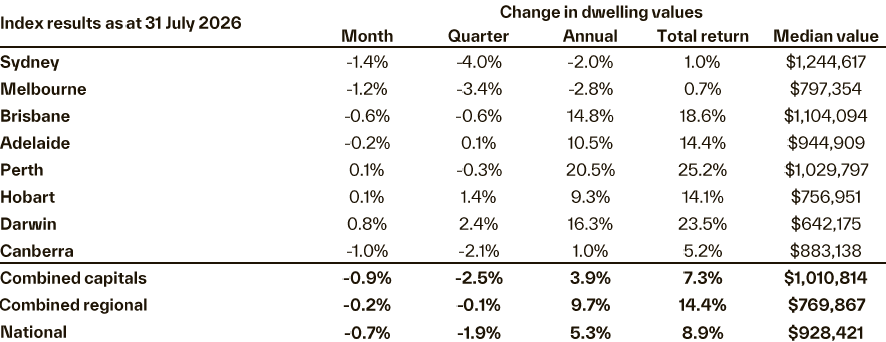
According to the Cotality Home Value Index August 2026, national dwelling values declined 0.7% in July, marking the largest monthly fall since December 2022.
Over the three months to July, national values declined 1.9%. Despite the recent downturn, Australian dwelling values remain 5.3% higher than a year ago.
Importantly, the slowdown is no longer concentrated solely in Sydney and Melbourne, with previously stronger capital city markets also beginning to experience softer conditions.
Sydney and Melbourne Lead the Decline
Sydney and Melbourne remained the weakest-performing capital city markets during July.
Sydney dwelling values declined 1.4%, while Melbourne recorded a 1.2% fall.
Brisbane and Adelaide also experienced declines during the month, while Perth remained broadly unchanged.
Darwin continued to outperform the other capital cities, with dwelling values increasing 0.8% in July and 16.3% over the past 12 months.
The broader slowdown reflects a combination of affordability constraints, higher borrowing costs, reduced borrowing capacity and weaker buyer confidence.
Buyers Are Gaining More Negotiating Power
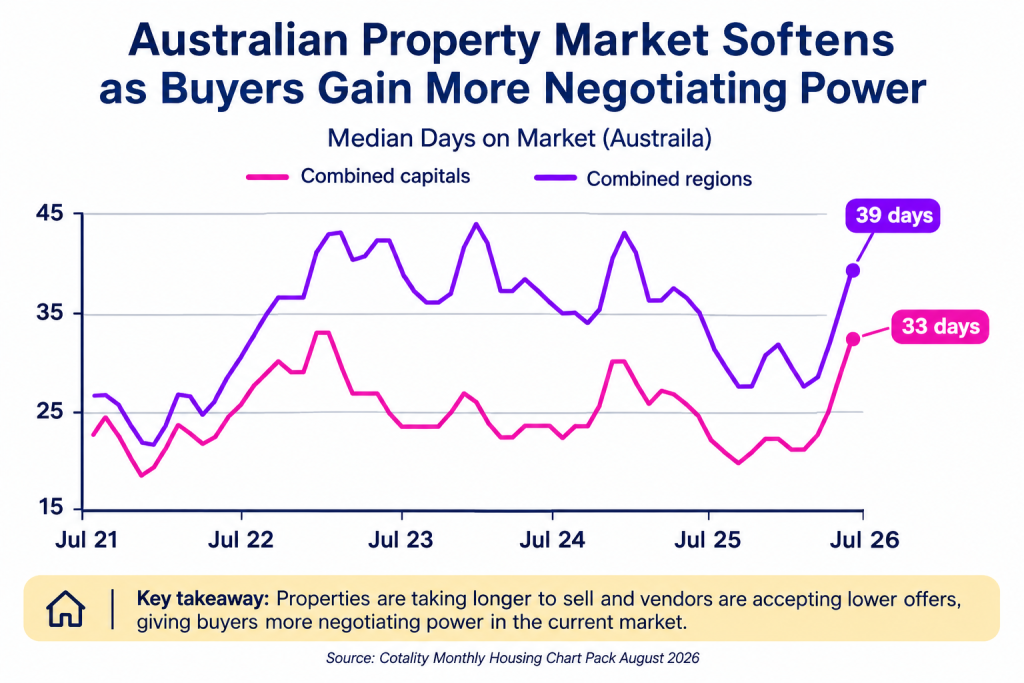
One of the clearest changes in the Australian property market is the shift in negotiating conditions.
Properties are taking longer to sell, while sellers are increasingly accepting discounts from their original asking prices.
Across Australia’s combined capital cities, the median time on market increased from 26 days in June to 33 days.
Vendor discounting has also widened, reaching a median 3.9% across the combined capitals, compared with 3.2% during the three months to April.
These trends suggest buyers may now have greater flexibility to negotiate, particularly where properties have remained on the market for longer periods.
More Properties Are Available for Buyers
The number of homes advertised for sale has continued to increase.
During the four weeks ending 9 August, there were 135,008 properties listed for sale across Australia, representing an increase of 14.9% compared with the same period last year.
However, this increase does not appear to be driven primarily by a surge in new properties entering the market.
National home sales declined 0.8% year-on-year, while sales across the capital cities were down 3.5%.
New listings were only 1.0% higher than a year earlier and remained 7.1% below the five-year average.
This indicates that properties are accumulating on the market because buyer demand has softened and homes are taking longer to sell.
For prospective buyers, this potentially means greater property choice and improved negotiating conditions.
Regional Australia Continues to Outperform Capital Cities
Regional property markets remain stronger than the combined capital cities on an annual basis.
Over the past 12 months, combined regional dwelling values increased 9.7%, compared with growth of 3.9% across the capital cities.
However, momentum is beginning to slow.
Regional dwelling values declined 0.2% in July, representing the first monthly fall across the combined regional markets since January 2023.
The performance gap between regional Australia and the capital cities may therefore continue to narrow if weaker buyer demand spreads further into regional markets.
Houses Still Outperform Units
Houses have continued to record stronger annual price growth than units nationally.
Over the past year:
- House values increased 5.7%
- Unit values increased 3.9%
However, both property types have weakened over the latest quarter.
House values declined 2.0%, while unit values fell 1.4%.
Interestingly, the lower end of the housing market has demonstrated greater resilience. Lower-quartile property values increased 0.3% over the past three months, compared with a 3.2% decline across the upper quartile.
Affordability pressures may therefore be encouraging more buyers to focus on lower-priced properties.
Rental Yields Continue to Improve
While property values have softened, rental market fundamentals remain relatively strong.
Gross rental yields across the combined capital cities reached 3.56% in July, their highest level since August 2019.
National rents increased 5.9% over the past year, while Australia’s vacancy rate edged higher to 1.7%.
Although vacancy has increased slightly, it remains well below the longer-term average of 2.4%, indicating that rental availability remains relatively constrained.
For property investors, the combination of softer purchase prices and improving rental yields may create opportunities in selected markets.
What Does the Current Market Mean for Buyers and Investors?
Australia’s housing market is clearly moving through a softer phase.
Declining dwelling values, slower sales activity, longer selling periods and increasing stock levels are shifting some negotiating power from vendors towards buyers.
Rather than viewing the national market as a single trend, buyers and investors should consider individual suburbs, property types, rental demand and long-term fundamentals when assessing opportunities.
For buyers who are financially prepared, increased stock and reduced competition may provide greater flexibility to negotiate and take more time when selecting a property.
For investors, improving rental yields combined with softer property values may also create opportunities in locations where rental demand and long-term population growth remain strong.